Will Reichelt
Many people would avoid accommodation that deliberately interrupts your sleep at an ungodly hour, but it’s a major selling point at James Turrell’s House of Light in Niigata, Japan. Hitting your alarm clock just before sunrise ensures you’ll wake up to a light bath that quietly dazes you with magenta, red, emerald and purple tones – the colours interacting with the transforming sky and dawning surrounds. This is the work of a major American artist who broke the record for the most-attended exhibition at New York’s Guggenheim museum – and you’re experiencing it while still in your pyjamas.
Located 200 kilometres north of Tokyo, House of Light is part of Echigo-Tsumari Art Field, a project that’s turned landscape into a sprawling open-air gallery. From the giant petals rising out of Yayoi Kusama’s Tsumari in Bloom sculpture in Matsudai to MAD Architects adding mirrored “dew drops” and a watery “light cave” to a 750-metre passageway overlooking Kiyotsu Gorge, there are 200 artworks scattered across 760 square kilometres. Some installations double as accommodation, such as Marina Abramovic’s Dream House (where you sleep in wooden coffins and contribute to the journal of 4000 dreams collected over 25 years) and Andrew Burns’s Australia House (which features Brook Andrew’s installation decorated with patterns inspired by his Wiradjuri heritage). And while Echigo-Tsumari Art Field is located entirely in Niigata, the prefecture is so vast, it would take nearly seven hours to walk from Australia House to House of Light.
Set on a remote hillside in the Tokamachi district, House of Light was completed in 2000 and is inspired by a traditional Japanese residence built in 1842 for the local Hoshina family, who traded in rice and sake – staples that power Niigata’s economy, as its plentiful rice paddies remind you. From the outside, House of Light doesn’t resemble a typical work by Turrell, who studied perceptual psychology and has spent more than 50 years playing with illuminations. Since achieving his pilot’s licence at 16, he’s clocked more than 12,000 hours in the skies: noticing atmospheric shifts, the dazzling palettes of sunsets and dawns and how light can both reveal and obscure. You see this in his work: some illuminated projections are featureless blocks of colour that wipe out your sense of depth perception. (A woman once mistook one of his light installations for a wall, fell down and sued New York’s Whitney Museum for injuries.)
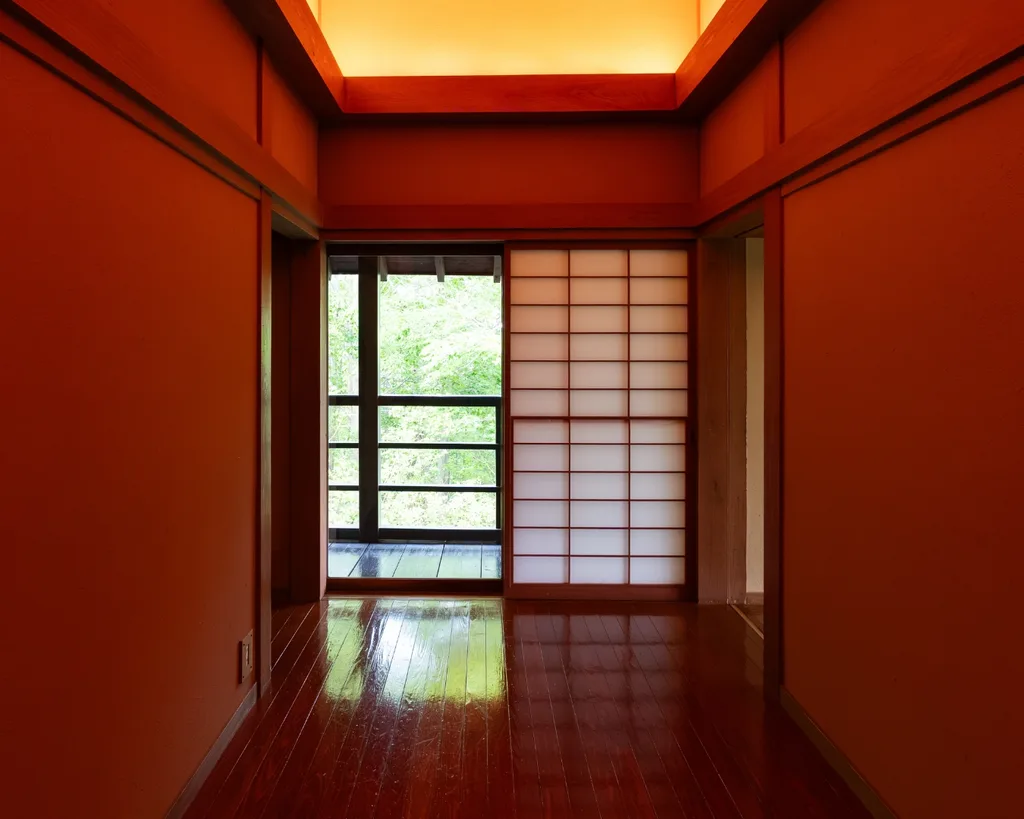
His futuristic experimentations with light and colour likely inspired Drake’s Hotline Bling music video, and Turrell’s installations have appeared in truly diverse locations, from a Louis Vuitton store in Las Vegas to various works glowing along Australia’s east coast, from his Rubik’s Cube-like strobes over Brisbane River to the slow dance of colours emanating from Amarna Skyspace at Hobart’s Museum of Old and New Art. These ultra-contemporary works contrast greatly with the timber façade of House of Light and its Gensho-stone entrance, where you remove your shoes before padding towards the building’s tatami rooms. Downstairs is a garden room, which overlooks a path of stepping stones. But these traditional Japanese features are exactly what Turrell wanted to highlight when art director Fram Kitagawa requested he create a “meditation house” for the area. This commission came with just one stipulation: keep the building 2.7 metres above ground level, because Niigata gets overwhelmed with snow during winter. When I visit, just a few weeks before the start of summer, banks of snow are still melting down the hillside.
The climate greatly affects your House of Light encounter, as the key attraction involves retracting the roof in the main tatami room to experience the twice-daily light show. It’s like staring at Turrell’s Skyspace at Hobart’s MONA, except you’re lying on a mat, surrounded by the Japanese countryside. The first light show is programmed for sunset and the other for sunrise – hence setting my alarm for 3.53am.
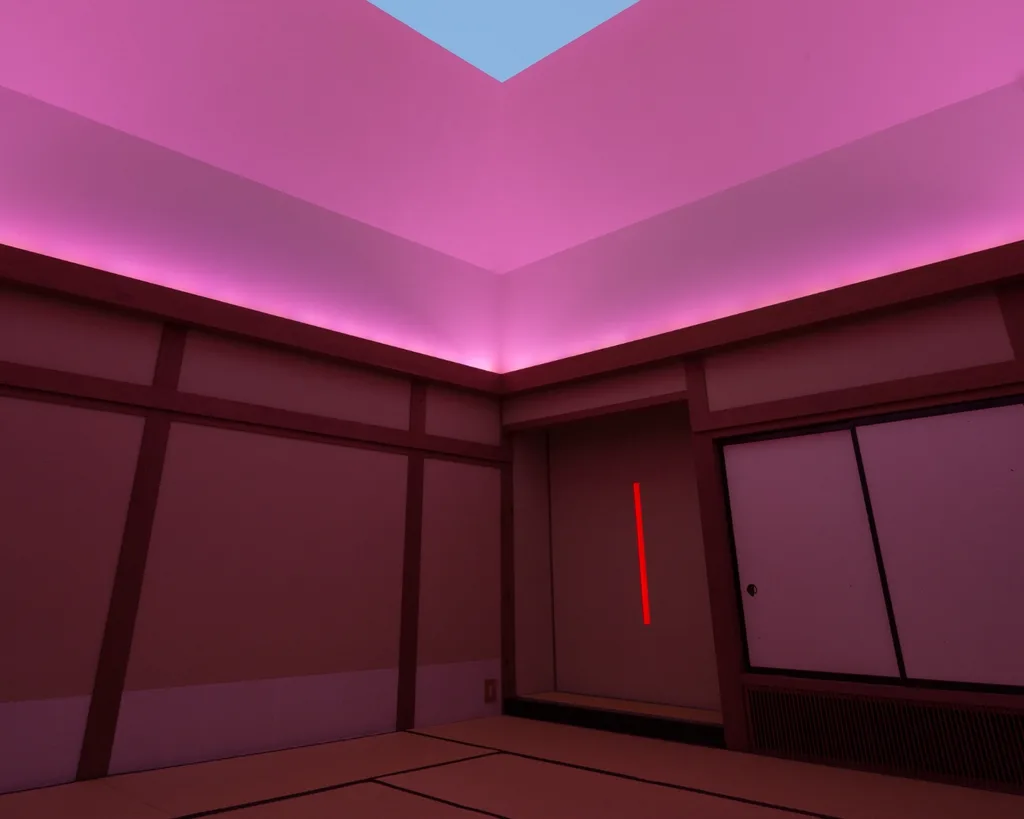
In collaboration with architect Daigo Ishii, Turrell wanted to showcase the building’s Japanese features. When you open the roof for the sunset light show, you notice how the colour illuminations differ across the room: tones are brightest above the nageshi beams and mute as they fall on the shoji (sliding paper doorways). The shape of the retracted roof doesn’t change, yet it seems to shift from square to rectangle and diamond as you move and the sky graduates from pearly white to night-time black.
The light show slowly pulses and sometimes the room is bathed in two tones at once, like a gas flame’s multiple hues. The walls turn bright as grapefruit soda, then creamy white like a vintage silk blouse. The sky is shimmering baby blue, then grey like denim jeans. A slit in the tokonoma (alcove) pulses red and my hand disappears into its sci-fi brightness. Its vivid stripe becomes more prominent as the sun sets: I hold its glow for a photo, like I’m carrying a lightsaber. When a party-killing “show’s over” shade of overly bright white fills the space, the sky looks like a clean black rectangle. When I close the ceiling hatch, it takes two minutes to slowly inch back into place, its wooden slats slowly replacing the sky I’ve spent the past hour viewing.
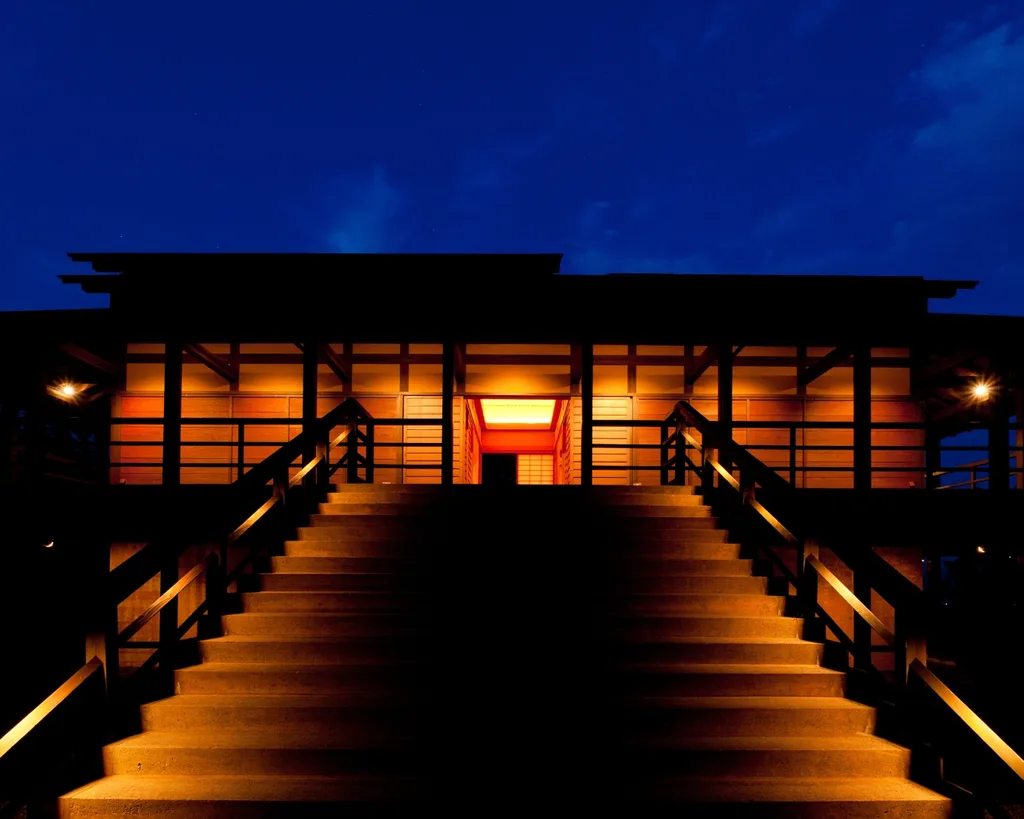
Junichiro Tanizaki’s influential 1933 essay, In Praise of Shadows, was a major influence on House of Light. His understanding of how darkness accentuates beauty is obvious in the entrance staircase. The steps are only lit from the edges, so their glow recedes towards the middle: it has a compelling visual charm, like a paper lantern’s accordion folds. Turrell lit the downstairs bath in minimal ways: fibre-optic strips of red and green run around the pool of water. A blue glow wraps around the door. Everything else is black. Splash through and there’s a disorienting optical effect where your body turns entirely white under water, while everything above the bath is obscured by darkness.
It feels like a scene from Tron or the album cover for a future Daft Punk record. It’s visually stunning and reminds you that at House of Light, every aspect – from rooftop to bathtub – is a literal work of art.

Related stories
Native ad body.
Native ad body.
Native ad body.